

Therapy for Loneliness: How Therapy Can Help

Photo by Pawel Czerwinski on Unsplash
Loneliness is not always what it looks like from the outside. You can be surrounded by people, even people who love you and you love back, and still feel it. That gap between what your life looks like and what it feels like can be its own kind of pain.
You might think that going to therapy for loneliness is just about hiring someone to just be there so you aren’t so alone. That’s not what it’s about at all. Rather, going to therapy for loneliness is more about learning what loneliness really is about and what relationships or experiences in your past may be influencing your ability to connect in the present. Therapy might also help you to uncover cultural patterns, fears, insecurities, or behaviors that could be standing in your way.
First, it helps to get a better understanding of what loneliness really is. There are many people who are alone and not lonely; at the same time, there are also many who have tons of relationships and are chronically lonely. Understanding the difference is key.
How Loneliness Shows Up
You might be the type of person who feels most alone when you are physically alone. You may feel fine, even energized, around others, but the moment you’re alone, something hollow sets in. The silence feels unbearable. And so, you fill every hour with plans because being alone feels like something to avoid at all costs.
Or you might experience the opposite. You feel settled in solitude and lonely the moment you step into a social situation. You’re physically present but feel removed, wondering why connection seems to come so naturally to everyone else.
Maybe, you recognize yourself in both. Loneliness can come and go, was and wain. Some days might be worse than others and you may not even recognize any pattern to your feelings of loneliness.
Trauma and Loneliness
As explored in the article 7 Reasons You Might Feel Lonely Even Though You’re Not Alone, trauma impacts the way you feel about yourself, people, relationships, and the world around you. Trauma shapes the way you think, what you expect, and therefore how you act, often in ways you aren’t even fully aware of.
When someone has experienced trauma, especially relational trauma, you learn that people are not safe and not to be trusted. This may have come from a parent who was absent or unpredictable, a relationship that turned painful, or repeated experiences of feeling unseen, rejected, or unworthy.
These experiences don’t stay in the past. They travel with you. Your past can become the lens through which you read new relationships, social situations, moments of potential closeness even when the danger is no longer there.
Not only may you have felt alone in the trauma itself, but you may also feel alone in carrying it. Similarly, you might feel like you’re the only one who has ever felt this way, or that what happened to you has left you somehow broken beyond repair.
That kind of belief can also make you believe that real connection, the kind where someone truly knows you, is not something available to you. And, so you might inadvertently reject opportunities, push people away, or avoid connection for fear of losing it.
The Shame of Feeling Lonely
Feeling ashamed because you’re lonely is a common experience, even if it rarely feels that way. Loneliness is a natural part of being human. It’s not a flaw or a failure; everyone experiences it at times. But when it goes unnamed, when there is no space to acknowledge it, it has a way of quietly turning into something heavier: shame.
You may have thoughts about how you should feel connected – you have no reason to feel alone. Yet, this does not make the loneliness fade. The gap between what you think you should feel and what you actually feel can be its own source of pain.
You wonder how other people manage to connect, belong, and let people in. In comparing to what you think others experience, you believe something must be wrong with you.
Shame then can become its own kind of isolation. It can keep you from reaching out and being honest about what you’re feeling. The loneliness quietly deepens because the shame of feeling lonely makes it harder to reach out for connection and support.
And, so, it continues, each feeding the other. The loneliness generates shame, and the shame deepens the loneliness. What makes this cycle so hard to break is that it doesn’t just feel bad, it starts to feel true. The mind begins organizing experiences around a story it created. This is called confirmation bias.
The Confirmation Bias Loop
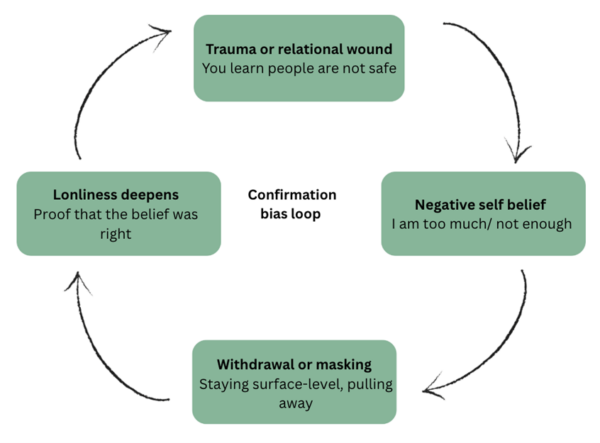
Confirmation bias is the mind’s tendency to seek out and hold onto information that proves what it already believes and discard anything that contradicts it.
When loneliness and low self-worth take root, the mind doesn’t look for evidence that you’re lovable, that connection is possible, or that people can be trusted. Rather, it looks for proof that you were right to be afraid.
Cancelled plans become abandonment. A quiet room becomes rejection. Awkward moments become confirmation that you don’t belong. The bias is quietly building a case against you. And the longer the cycle continues, the more convincing that case feels.
You Are Not Beyond Help
If you’ve read this far and recognized yourself, there’s a chance you’ve already tried to do something about your feeling of loneliness. You may have pushed yourself to go out when you didn’t want to. Or you’ve told yourself to stop overthinking, time and time again only to find yourself ruminating in the middle of the night. Maybe you’ve had moments where it seemed to be working, only to find the feeling quietly return.
This is not evidence that you’re beyond help. Instead, it’s a fact that the root cause of your loneliness can’t just be willed away. You can understand intellectually that the person who cancelled plans is not abandoning you, yet it stills feels abnormally painful anyway.
Therapy for Loneliness
Much of what drives the loneliness cycle happens beneath the surface. You may not even realize that the reason you cancel plans, keep conversations shallow, or feel alone in a room full of people is due to something that happened years ago.
Relational therapy, or depth-oriented work, gently brings these patterns into awareness. Therapy helps you to understand where these patterns came from, why they made sense at the time, and how it is still shaping your life today. Understanding is not the whole answer, of course, but it is a necessary beginning.
In some kinds of therapy, like relational therapy, the therapeutic relationship itself is part of the healing process. For many people whose loneliness stems from early relational wounds, the experience of being in a consistent, safe, and attuned relationship can be something entirely new. Over time, that experience begins to offer something that past experiences made feel impossible: proof that you can feel safe in connection with others.
Just like any relationship, there are moments where there is misattunement, misunderstanding, or conflict. In therapy you learn to navigate those moments without the relationship falling apart. You experience repair. For someone who learned that conflict means abandonment, or that showing a need leads to rejection, the experience of working through difficult moments in a safe way is part of the healing as well.
Therapy for loneliness also works to interrupt the confirmation bias loop. The old narrative – that you’re too much, not enough, fundamentally unlovable – gets gently and consistently challenged. Through consistency, trust, working through conflict and uncomfortable moments week after week, your system starts to realize that something different is possible.
Therapy can also offer a space to rebuild your relationship with yourself. You can learn to develop self-awareness, self-compassion, and acceptance of all parts of you (as opposed to trying to hide or avoid those parts). Because the more at home you feel within yourself, the more available you become for genuine connection with others.
You do not have to keep navigating this alone. Therapy is not about being fixed. Rather, it’s about being met where you are and finding your way back to yourself and to others. If you are curious about what that could look like, we invite you to reach out for a free consultation.







Leave A Comment